Two numbers, moved at once
Most developers treat branded residences as a marketing decision: which logo goes on the gate and how much more can we charge. That framing is not wrong, but it is shallow and it leaves most of the value unclaimed. A brand changes two numbers at once: the price a buyer will pay and the speed at which buyers commit. Move both together and the effect on returns is not additive. It is multiplicative.
This paper proves that claim with a fully specified development model, then stress-tests it. We take one piece of land, one building, one cost base and run it two ways: as independent luxury and as a branded residence. Everything physical is held constant. We then load the branded case with every real cost a brand imposes, a licensing fee, a technical services fee, a brand marketing contribution, a higher construction specification and richer amenities and we measure everything after developer overhead, brokerage, finance and corporate tax. The brand is not given a free pass. It has to earn its premium against its own cost, on a post-tax basis.
Branded residences are not a real estate product. They are a capital efficiency strategy.The Framework
The NOESIS Triangle of Value Creation™
Every branded residence that creates real wealth satisfies three conditions at once. We map them onto a triangle because a triangle is the most stable structure there is and because it fails the moment any one side gives way.
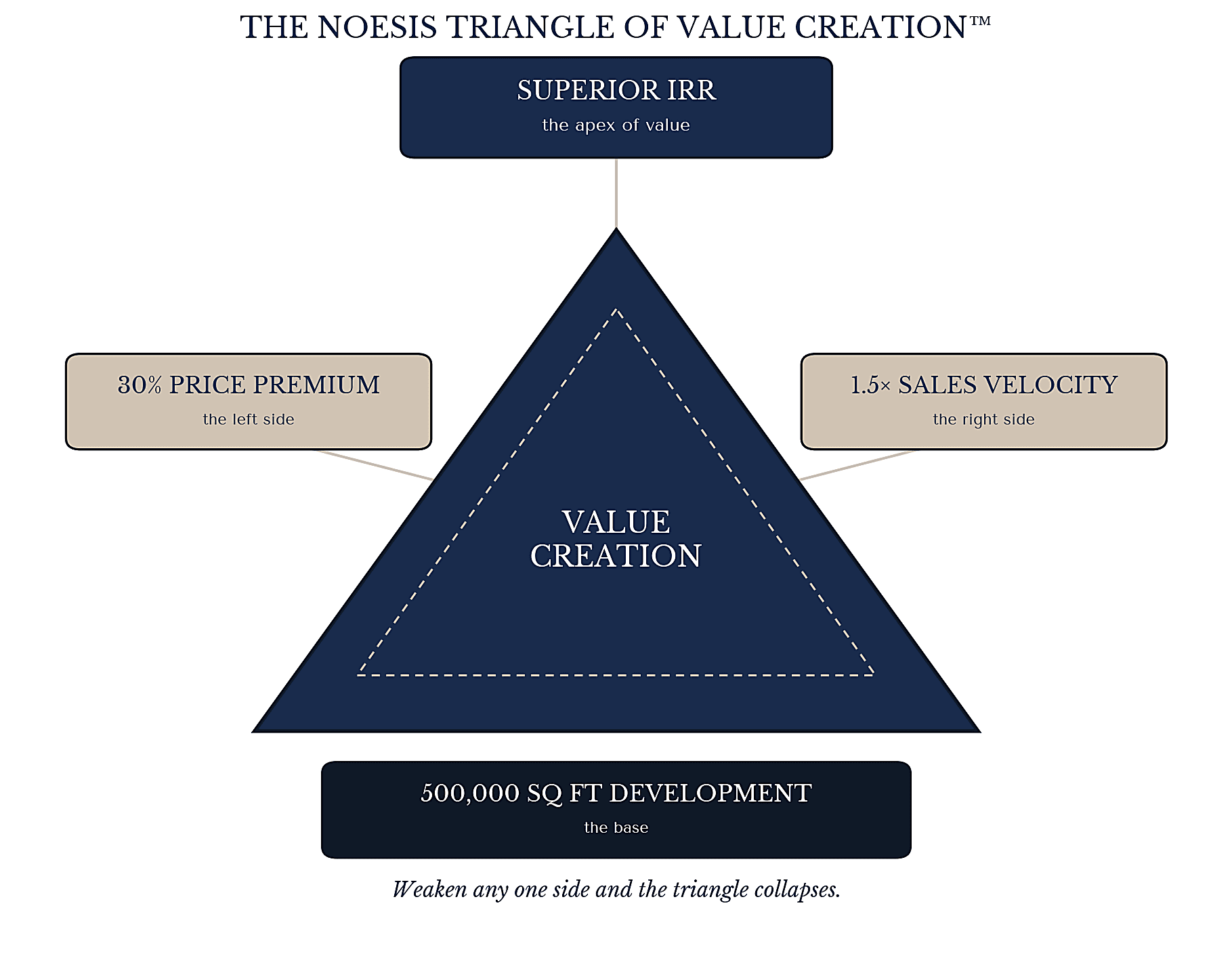
The base is scale. A 500,000 sq ft development is large enough to attract a serious brand, justify the operating infrastructure and move the numbers that matter.
The left side is the price premium. A correctly positioned branded residence can command 25 to 40 percent over comparable unbranded inventory in a strong Indian market. We model a conservative 30 percent.
The right side is sales velocity and it is bought with trust. A buyer looking at an unbranded scheme is underwriting three promises at once: that the building gets delivered, that it is finished to the standard shown and that it is still run properly ten years later. A brand answers all three before the buyer walks into the sales lounge and that is what shortens the decision. On genuine demand, a branded scheme absorbs roughly 1.5 times faster than the same building sold without a flag.
The apex is the internal rate of return. It is an outcome, not a lever. Weaken any one side and the apex falls with it.
The PremiumWhere the premium comes from and whether it lasts
A premium is only bankable if its drivers are real and durable. Four forces create it: transferred trust (the brand has underwritten the developer, the design and the delivery, so the buyer prices out execution risk); a verifiable service standard that persists after possession; scarcity of organised, professionally operated inventory in the micro market; and a global buyer pool, including non-resident Indians, who recognise the brand and transact in larger tickets, often without buyer financing.
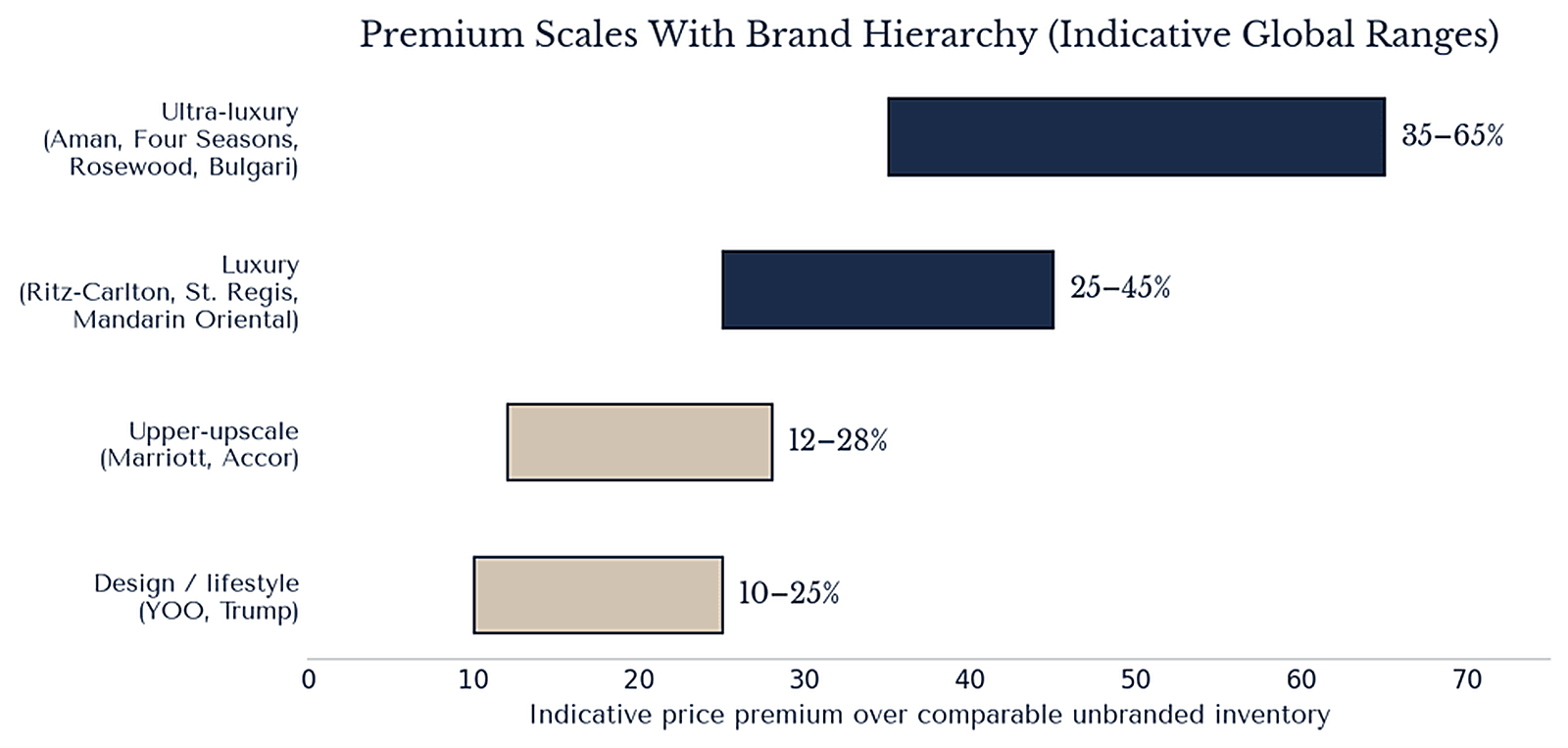
The premium is not uniform. It scales with brand hierarchy and with market. An ultra-luxury name in a supply-starved leisure market sits at the top of the range; an upper-upscale flag in a deep, competitive metro sits near the bottom. Selecting a brand above or below the market the asset can actually support is the most common way developers either overpay in fees or leave premium on the table.
Indicative global ranges observed across markets; actual premium is asset and market specific and must be established through feasibility, not assumed.
On sustainability: the premium persists only where the brand keeps managing to standard. A weak operator, a diluted brand, or a developer who treats the flag as signage will see the premium erode at resale. The premium is rented from the brand, not owned. It is maintained by performance.
The premium is rented from the brand, not owned. It is maintained by performance.
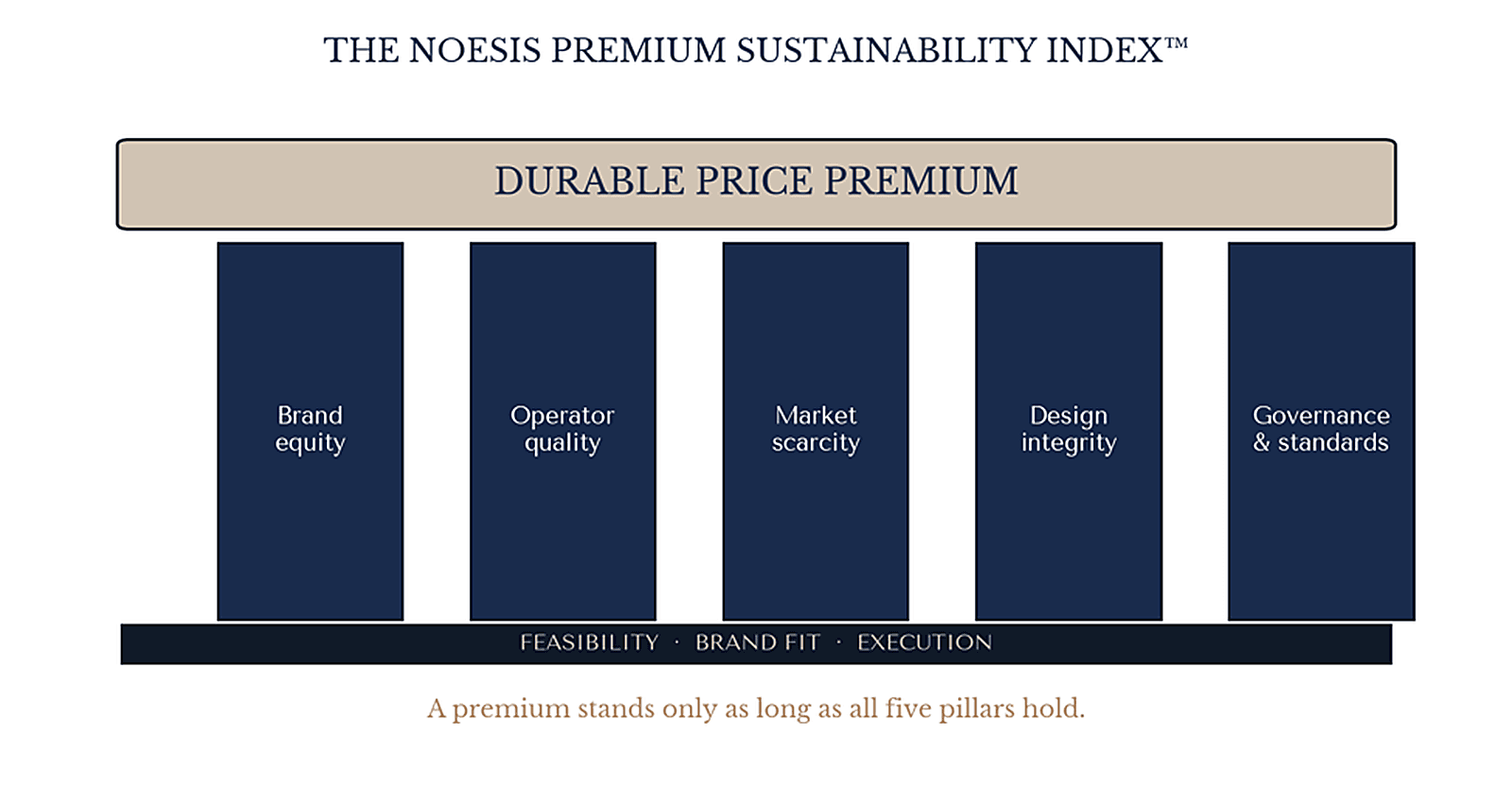
The NOESIS Premium Sustainability Index™
A premium is an asset on the developer's balance sheet only if it survives to resale. Five forces decide whether it does. We score them, because an unsustainable premium is a liability dressed as an asset.
Brand equity sets the ceiling. Operator quality defends it day to day. Market scarcity protects it from new supply. Design integrity earns it at handover. Governance, the enforcement of brand standards over decades, is what stops it eroding. Remove any pillar and the premium decays toward the unbranded price, taking the developer's pre-sales story with it. This is why brand selection is a feasibility question, not a marketing one.
A 500,000 sq ft luxury project in North Goa
A beachfront-adjacent luxury development in North Goa, a strong leisure market with little organised premium inventory. The land is acquired, designed and built once. The developer then chooses between two go-to-market strategies. The branded case is deliberately burdened with its true costs.
| Parameter | Value | Basis |
|---|---|---|
| Saleable area | 500,000 sq ft | Project scale |
| Land cost | ₹280 cr | Premium North Goa parcel |
| Base construction | ₹520 cr | ₹10,400 / sq ft, luxury spec |
| Soft costs | ₹110 cr | Design, approvals, infra, RERA, contingency |
| Construction period | Approx. 42 months | Completes end of Year 3 |
| Construction finance | 12% p.a. | Drawn as needed, swept by collections |
| Developer equity | ₹300 cr | Balance via debt and pre-sales collections |
| Collection schedule | 40 / 35 / 25% | Construction-linked, over 3 yrs from booking |
| Equity discount rate | 18% | Cost of equity, used for NPV |
| Lever | Scenario A: Independent | Scenario B: Branded |
|---|---|---|
| Average selling price | ₹30,000 / sq ft | ₹39,000 / sq ft (+30%) |
| Sales velocity | 100,000 sq ft / yr | 150,000 sq ft / yr (1.5×) |
| Construction spec | Base | +5% (brand standard) |
| Amenity capex | Base | +₹40 cr (branded amenities) |
| Brand licence fee | – | ₹15 cr upfront |
| Brand fee on sales | – | 3.0% of GDV |
| Technical services fee | – | 0.5% of GDV |
| Brand marketing levy | – | 1.0% of GDV |
| Own marketing | 5.0% of GDV | 2.5% of GDV |
The branded case carries roughly ₹103 cr of brand-related fees plus a ₹66 cr construction and amenity uplift. It is not the cheaper option to build. It is the more profitable option to own.
The ResultTwo outcomes from one building
| Financial output | Scenario A: Independent | Scenario B: Branded |
|---|---|---|
| Total revenue (GDV) | ₹1,500 cr | ₹1,950 cr |
| Total development cost | ₹1,090 cr | ₹1,264 cr |
| Finance cost | ₹71 cr | ₹32 cr |
| Profit before tax | ₹339 cr | ₹654 cr |
| Corporate tax (25%) | (₹85 cr) | (₹164 cr) |
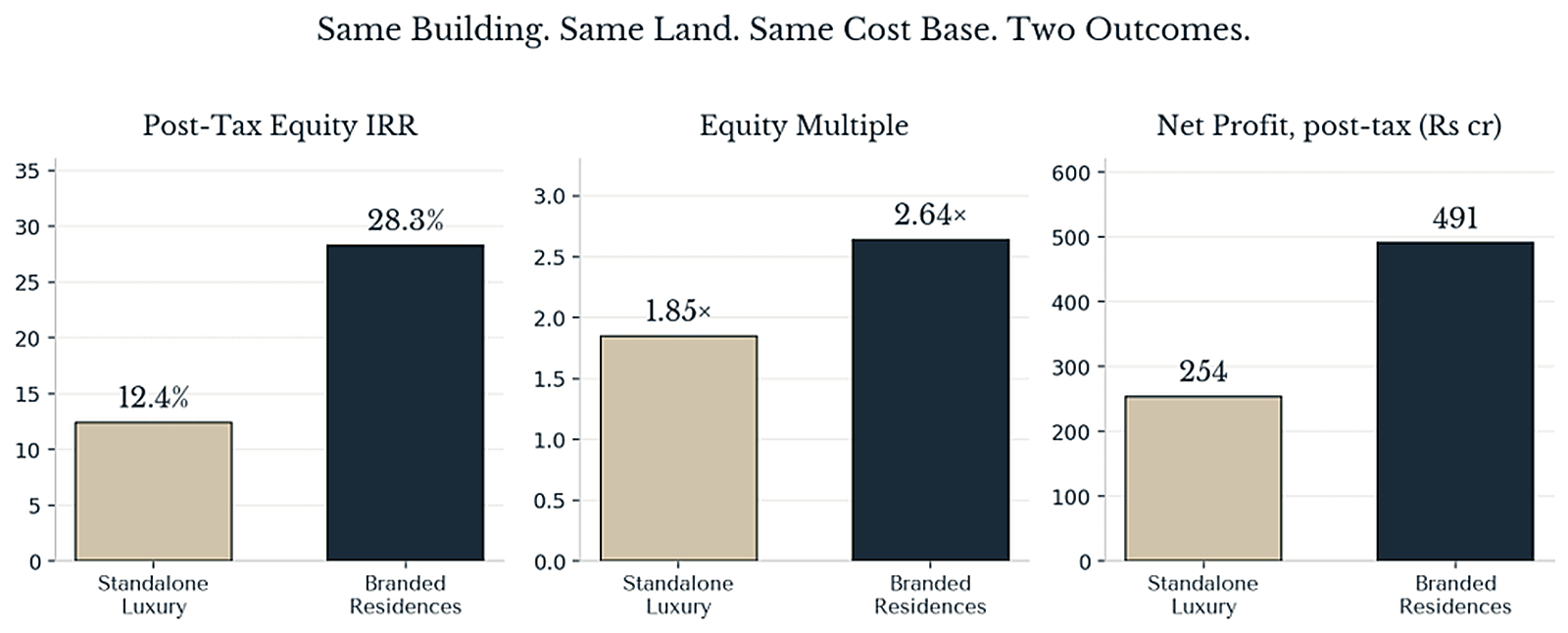
| Profit after tax | ₹254 cr | ₹491 cr |
| Development margin (on GDV) | 17% | 25% |
| Peak debt drawn | ₹219 cr | ₹148 cr |
| Pre-sales cover of peak debt | 2.9× | 8.5× |
| Equity invested | ₹300 cr | ₹300 cr |
| Equity multiple (post-tax) | 1.85× | 2.64× |
| Equity NPV at 18% | (₹67 cr) | +₹113 cr |
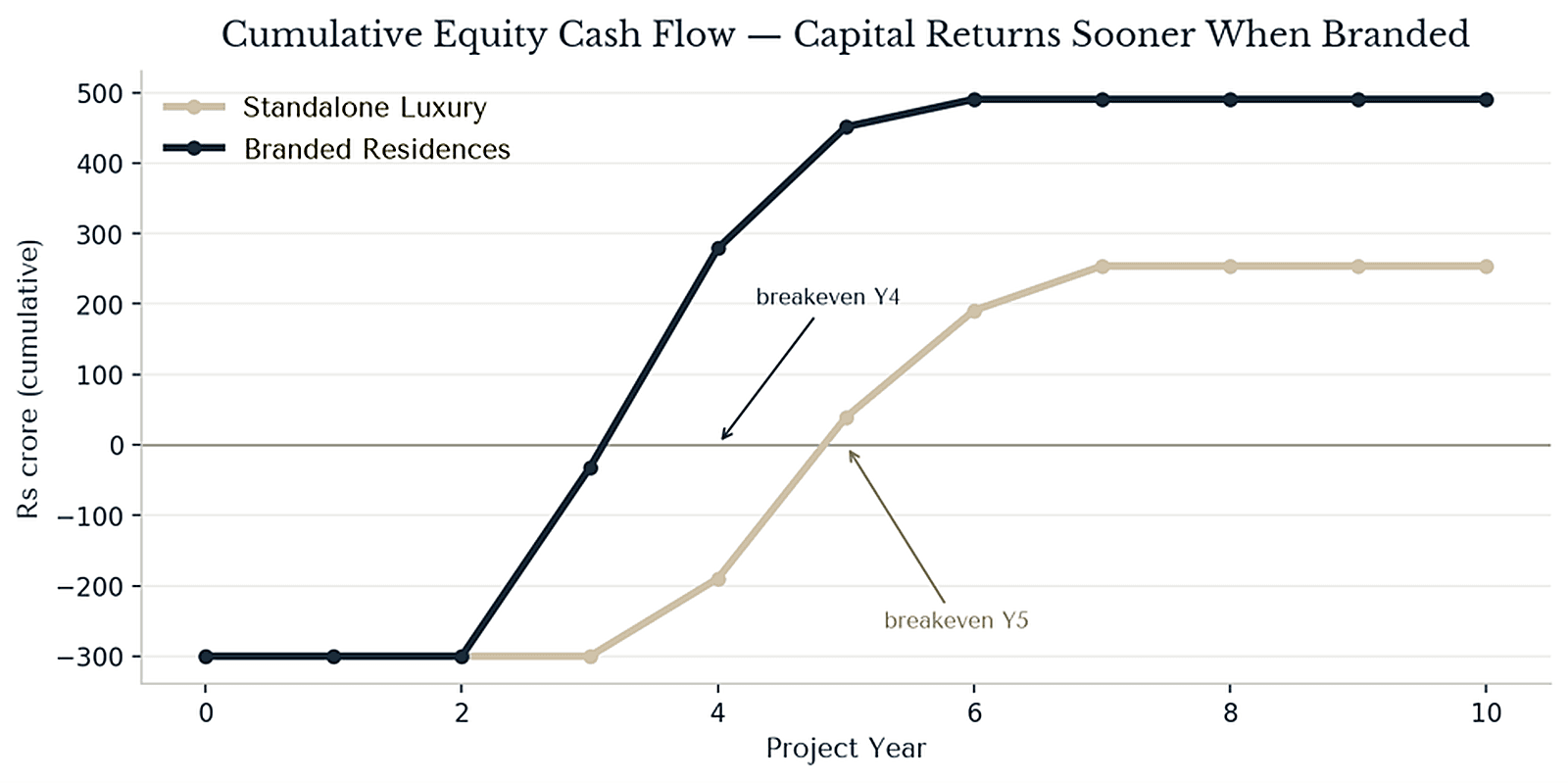
| Equity payback | Year 5 | Year 4 |
| Post-tax equity IRR | 12.4% | 28.3% |
+30%
Price premium
+93%
Profit after tax
12 → 28%
Post-tax IRR
+₹180 cr
NPV swing
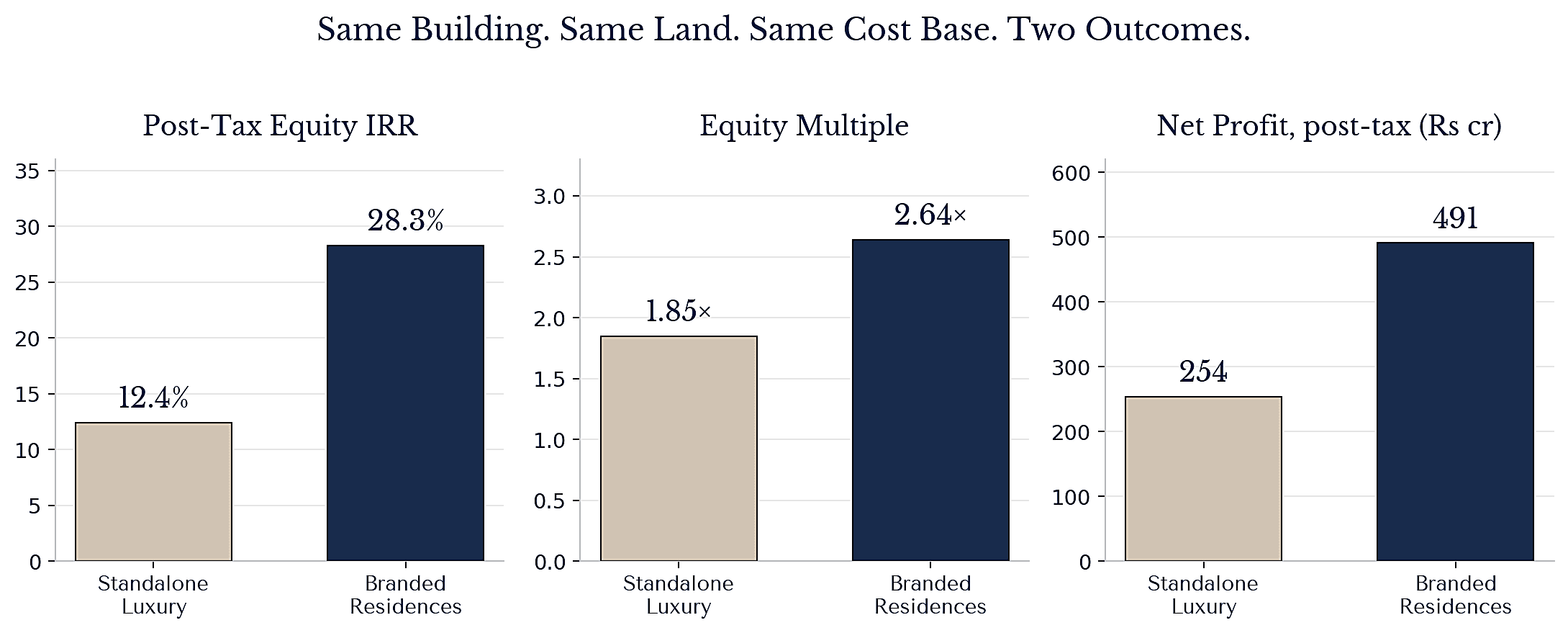
Read the bottom of the table carefully, because it says something sharper than “higher returns.” On these assumptions the independent project earns a 12.4 percent post-tax equity IRR against an 18 percent cost of equity. Its NPV is negative ₹67 cr. It destroys value. The same building, branded, earns 28.3 percent and a positive ₹113 cr NPV. A 30 percent price premium did not merely lift the return. It carried the project across its cost of capital, from value-destroying to value-creating, an NPV swing of ₹180 cr. That is the hidden science of branded residences and it survives a fully loaded, post-tax cost base.
A independent luxury project can clear its sticker price and still fail its cost of capital. The brand is what crosses the hurdle.The Bridge
Decomposing the Return: Sixteen Points, Line by Line
An institutional reader does not accept a result; they want it decomposed. The bridge below attributes every point of the move from the independent 12.4 percent to the branded 28.3 percent.
The price premium contributes roughly 12 points of IRR. Sales velocity contributes another 10, almost as much as the premium itself, by pulling cash forward and cutting finance cost. The fully loaded brand cost, fees plus spec and amenity uplift, gives back about 6 points. The net is a project that moves from below its cost of capital to comfortably above it. Premium and velocity are not one lever and a bonus. They are two engines of comparable size, which is the entire logic of the triangle.
Velocity is the cheapest capital in real estate. It is paid for by the buyer, not the bank.The Mechanics
Why a 30% premium more than doubles the return
IRR rewards how much is made, how fast, on how little capital tied up for how long. Branded residences improve every one of those variables at once and they compound.
More revenue on a barely larger cost base. The 30 percent premium adds ₹450 cr of revenue. After brand fees, the spec uplift, overhead, brokerage and tax, post-tax profit still rises 93 percent.
Faster collections pull cash forward. Selling 1.5 times faster returns the developer's money sooner. Equity breaks even in Year 4 rather than Year 5 and the bulk of cash returns far earlier. In IRR terms, time is the most valuable variable and velocity buys it.
Lower carrying and finance cost. Peak debt falls from ₹219 cr to ₹148 cr and finance cost from ₹71 cr to ₹32 cr, because faster pre-sales fund the build instead of borrowings. The branded project is, in effect, financed by its own buyers.
Higher capital efficiency. Post-tax profit per rupee of equity rises from 0.85 to 1.64 times. The same ₹300 cr of equity recycles a year sooner into the next project, compounding across a development cycle.
Branded equity turns cash-positive two years earlier; the area between the curves is pure IRR advantage.
A 30% increase in price does not create a 30% increase in IRR. It creates a multiplier.The Land Truth
A brand is a land-acquisition weapon
Here is the consequence developers feel first, at the auction, not at handover. Run the model backwards and solve for the most a developer could pay for this parcel and still earn an 18 percent cost of equity. As independent luxury, the answer is ₹178 cr. As a branded residence, it is ₹453 cr. The brand more than doubles residual land value, by ₹276 cr on a single site.
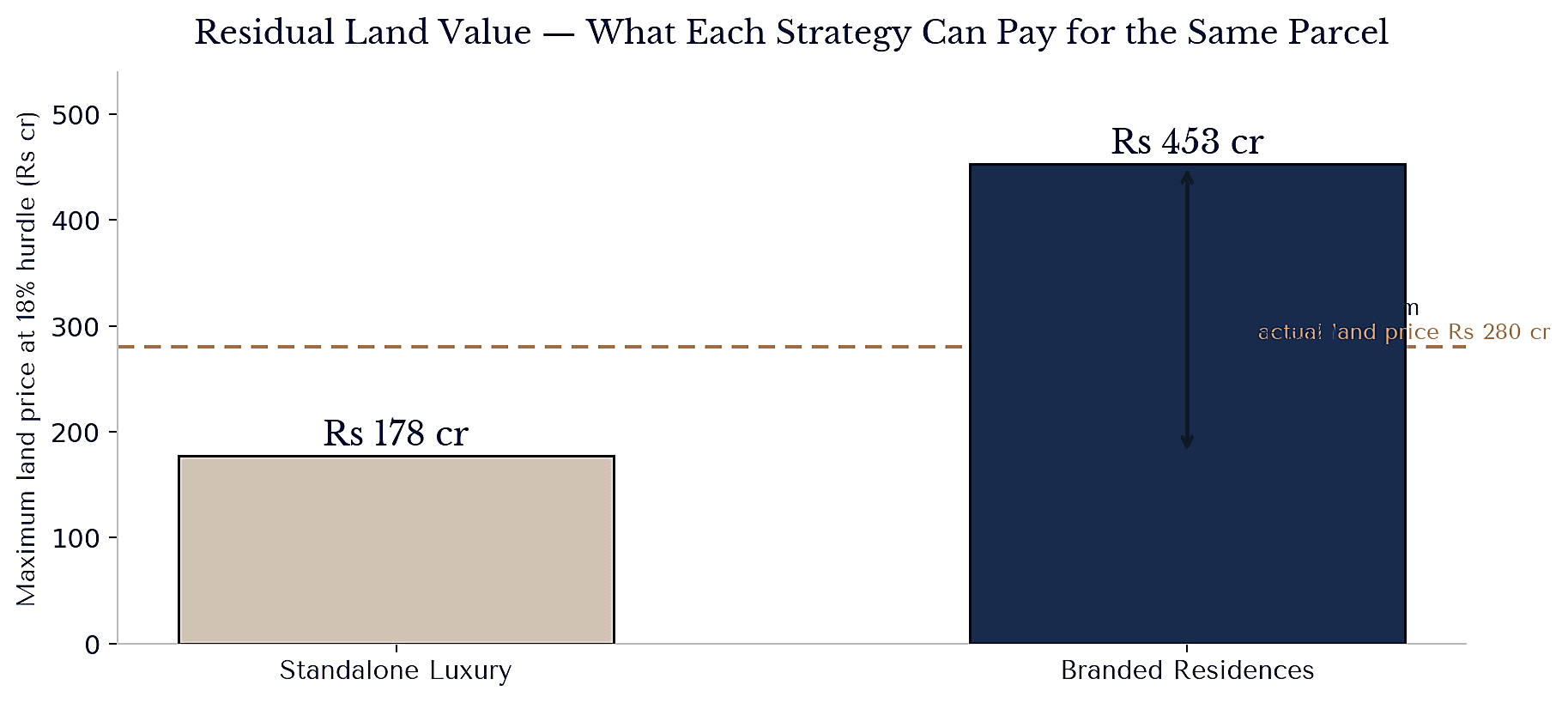
This explains the earlier finding precisely. At the ₹280 cr the parcel actually costs, the independent scheme is overpaying for land it cannot justify, which is why its NPV is negative. The branded scheme justifies that land with ₹173 cr to spare. In a competitive land market, this is decisive: the developer who underwrites a branded outcome can outbid the developer who does not and still clear the hurdle. The premium does not merely improve a project. It decides who wins the site.
A brand does not just raise your return. It raises what you can afford to pay for the land.The Capital Stack
What the lender sees
A construction lender does not underwrite glamour. It underwrites the gap between cost and collections and the confidence that the gap closes on schedule. Branded residences improve both the size and the reliability of that gap.
Because the branded scheme pre-sells faster, collections arrive earlier and the peak debt requirement is a third lower, ₹148 cr against ₹219 cr. Pre-sales over the construction window cover peak debt roughly eight and a half times over, against under three times for the independent scheme. Lower leverage, faster repayment and a thicker pre-sales cover mean a lower loan-to-cost, a shorter exposure and a materially lower probability of a cost-overrun or slow-sales scenario forcing a workout. For the lender, the brand is a risk mitigant before it is anything else and that should translate into finer pricing and higher gearing availability for the branded structure.
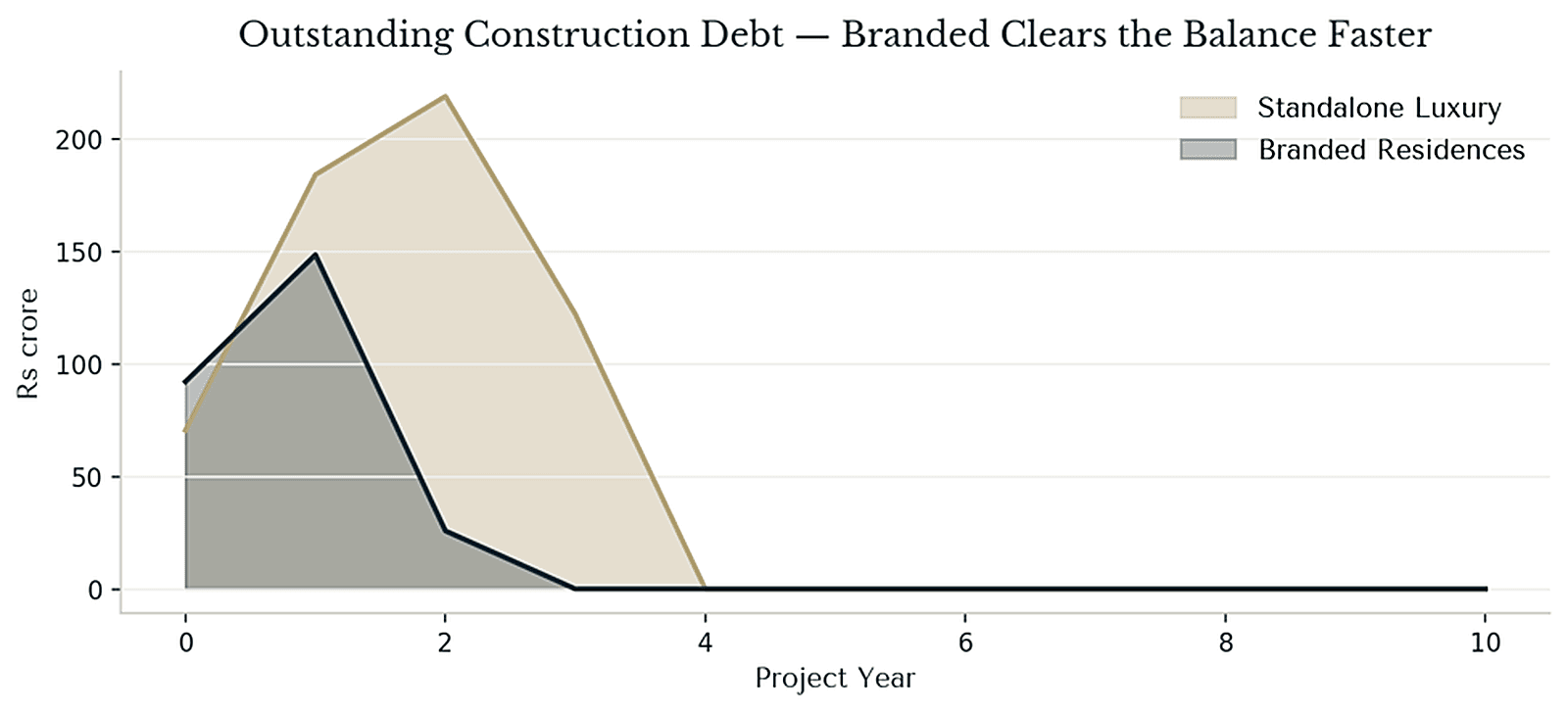
For the lender, the brand is a risk mitigant before it is anything else.
That lower risk also buys leverage. Because the branded scheme draws less debt and repays it faster, it safely carries more gearing. Holding the structure constant and committing less equity lifts the branded equity IRR from 28 percent at ₹300 cr of equity to roughly 34 percent at ₹200 cr, with peak debt still well covered by pre-sales. The conservative base case understates the levered potential; it does not overstate it.
The InvestorsFour pools of capital, one conclusion
Different capital underwrites different things. The branded structure answers each on its own terms.
Private equity underwrites IRR and exit. Faster absorption shortens the hold and lifts the IRR; the branded resale premium and longer demand tail protect the exit. A branded scheme fits a closed-end fund's clock better than independent inventory that lingers.
Family offices underwrite capital preservation and legacy. A professionally operated, brand-governed asset holds value across cycles and transfers cleanly across generations. For patient Indian family capital, that durability matters more than a marginal point of IRR.
Banks and NBFCs underwrite the gap and the cover. Lower peak debt, an eight-times pre-sales cover and faster repayment mean a lower loan-to-cost and a shorter exposure. The branded loan is simply a safer loan and should price and gear accordingly.
Sovereign and institutional platforms underwrite scale and governance. Branded residences are repeatable, benchmarkable and governed to a global standard, which is what allows a single asset to become a programmatic platform across cities. Independent luxury does not institutionalise; branded does.
Developers sell square feet. Capital buys certainty. The brand manufactures certainty.The Exit
The premium that outlives the developer
Most developer analysis stops at sell-out. Capital does not. A branded residence carries its premium into the secondary market, where global evidence shows branded units transacting at a meaningful resale premium and reselling faster than unbranded peers in the same building or micro-market. For the original buyer, that is a more liquid, more resilient store of value; for the developer, it is what makes the pre-sales argument credible in the first place, because buyers price in their own exit. Where the asset includes an income component, the brand also compresses the capitalisation rate a future institutional buyer will accept, lifting exit value beyond the unit-sale premium. The brand is the only input in the model that keeps working after the developer has left the project.
The SensitivityStress-Testing the Thesis
A single point estimate is not an argument. The grid below runs the branded equity IRR across the full range of the two triangle sides, premium on the horizontal, velocity on the vertical, with the loaded brand cost applied throughout.
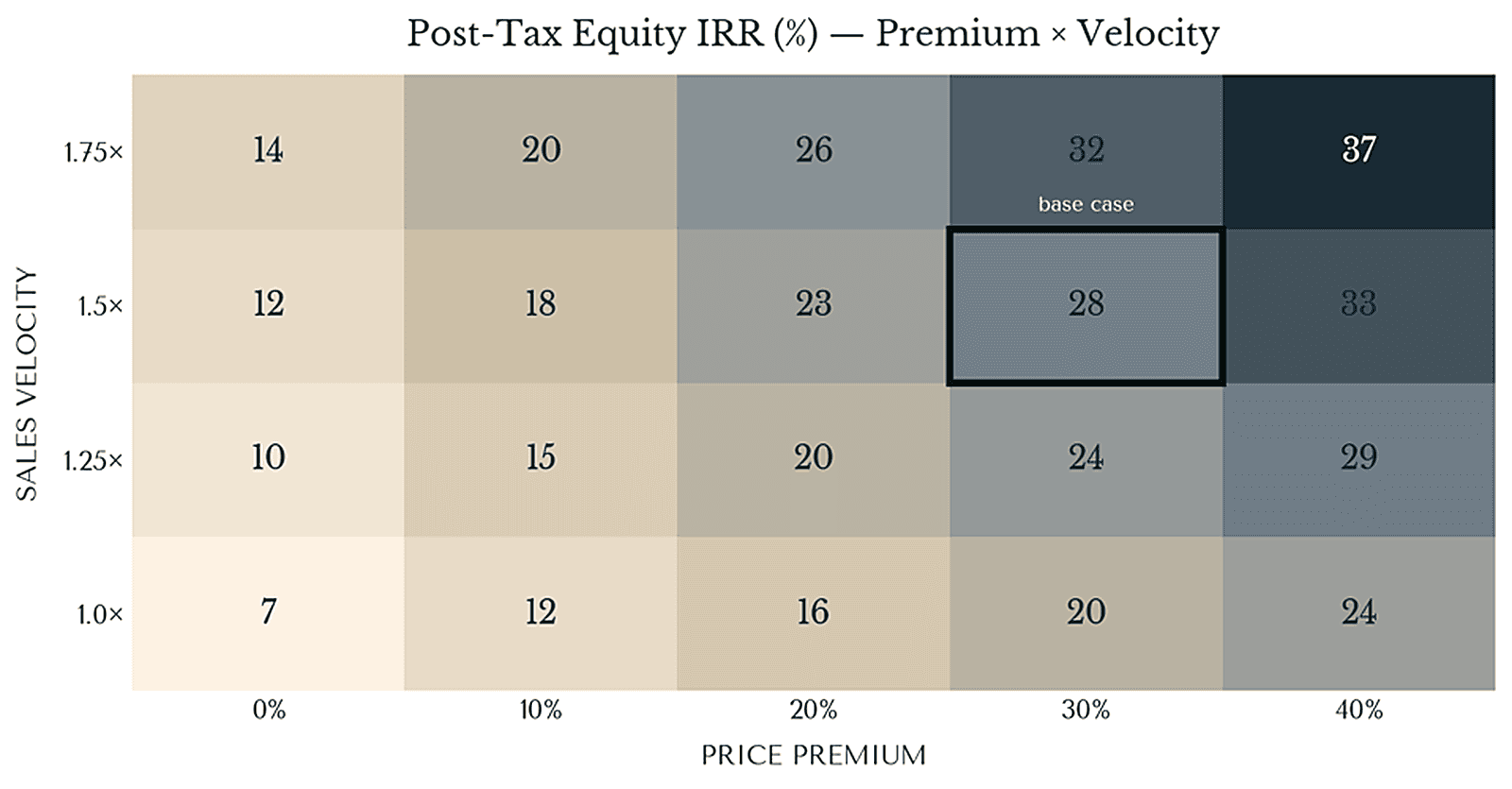
Three readings matter. First, premium alone, at 1.0× velocity (bottom row), reaches about 20 percent at a 30 percent premium, only just touching the cost of equity. Second, velocity alone, at no premium (left column), stays in single digits to low teens, because selling an ordinary product faster does not create value. Third, the two together reach 28 percent and clear the hurdle decisively. Only the upper-right of the grid, where both sides are strong, comfortably beats an 18 percent cost of equity. This is the triangle, quantified.
The collapse case is the warning. Hold the premium at 30 percent but let velocity fall to 1.0, the signature of a wrong brand that wins no demand pull and IRR falls from 28.3 to 19.8 percent. You lose roughly eight and a half IRR points and a year of capital lockup while still paying full brand fees. Worse, the top-left of the grid shows a brand that delivers neither premium nor velocity returning a single-digit IRR, after you have spent more than ₹170 cr of fees and uplift to earn it. That is not a branded residence. That is a logo and it destroys value.
The DownsideThe risk-adjusted view
Underwriting on the base case alone is how developers get hurt. Take a deliberately conservative branded case: a 15 percent premium rather than 30, velocity of only 1.25 times, and a higher 13 percent cost of debt to reflect a tighter market. Even then the branded structure delivers a 16.9 percent post-tax IRR, close to the cost of equity and still far ahead of the independent base case of 12.4 percent. The honest reading is twofold. Branding is not alchemy: in a genuinely weak market a branded scheme can sit near its hurdle too. But across the full band of outcomes the branded structure consistently outperforms the unbranded alternative by a wide margin and only the branded structure ever clears the hurdle with room to spare. That asymmetry, strong upside, defended downside, is exactly what a risk-adjusted return should look like.
The DisciplineWhen not to build branded
A thought leader earns trust by naming the cases where the strategy fails. Do not build branded when the market is too thin to sustain the premium, because the fees will outrun the uplift. Do not build branded when the parcel is sub-scale, because it cannot carry the amenity and operating infrastructure a credible brand demands. Do not build branded when the developer cannot execute to brand standard or on time, because the brand will exit and take the premium with it. And do not build branded as a rescue for a weak location; a brand amplifies a sound thesis, it does not repair a broken one. The branded route is powerful precisely because it is conditional. Treating it as universal is the fastest way to convert it from an asset into a cost.
The wrong brand is not a missed opportunity. It is a capital-allocation error.The Framework
The NOESIS Brand Selection Matrix™
If feasibility decides whether to brand, this decides which brand. Plot the brand tier against the market's depth and willingness to pay. Value is created on the diagonal, where the two are matched. Above it, the developer pays ultra-luxury fees a market cannot reward. Below it, an under-scaled brand leaves premium uncaptured.
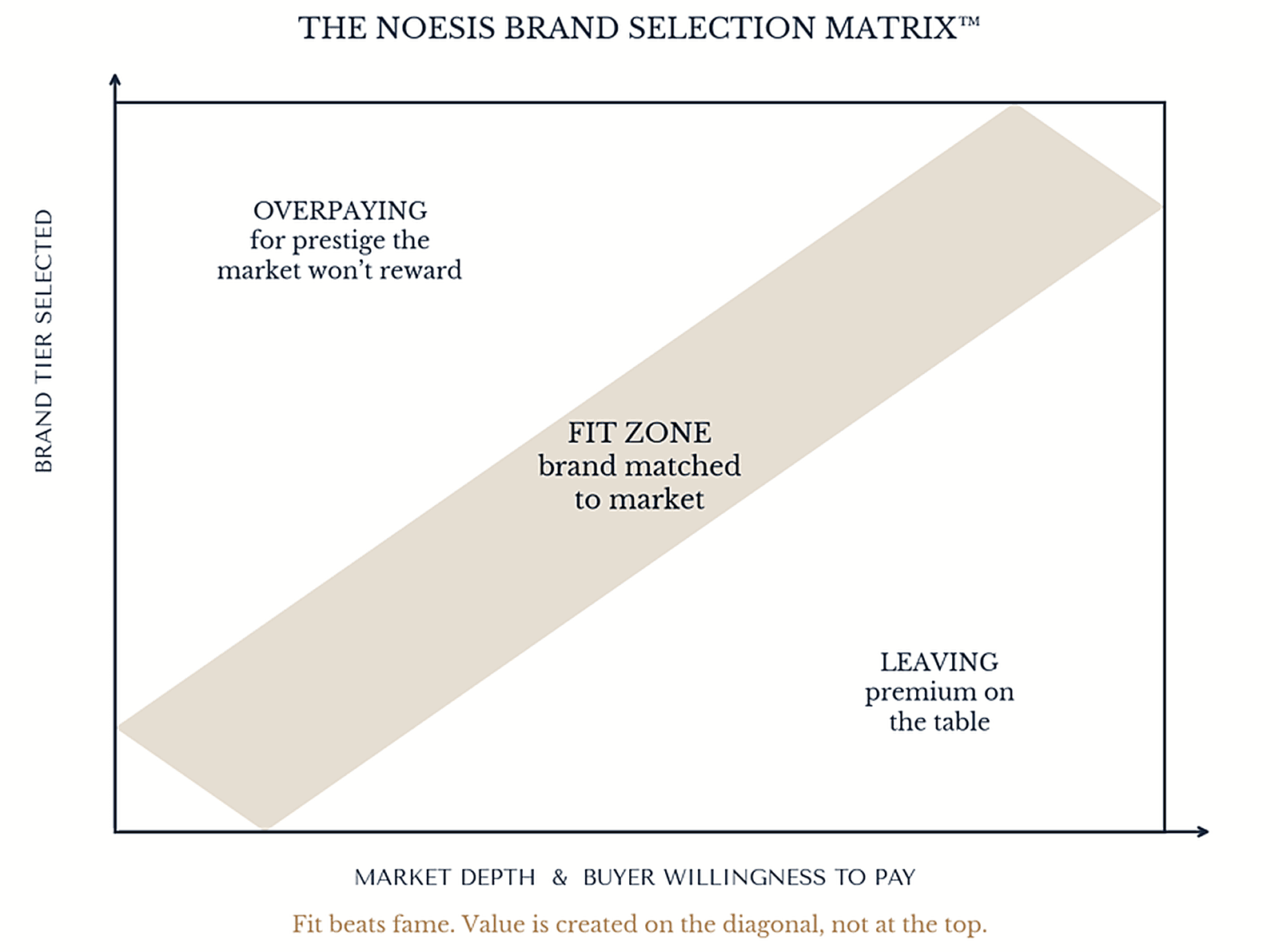
The most expensive error in this asset class is not choosing a weak brand. It is choosing a strong one the market cannot pay for, then carrying its fees against a premium that never materialises. Fame is not fit. The right brand is the one the buyer trusts and the market can support, which is an analytical question, not an aspirational one.
The EvidenceThe Brands Have Already Run This Experiment
Each major brand is a lesson in a different financial truth. Read as a portfolio, they make the case better than any single project can.
| Brand | The financial lesson |
|---|---|
| Aman | Engineered scarcity sustains the highest premium in the category; supply discipline is a pricing strategy, not a constraint. |
| Four Seasons | Operational consistency is what makes a premium durable; the resale premium tracks service reliability, not the logo. |
| Ritz-Carlton / St. Regis | Scale and recognition compress velocity risk; a deep brand pulls buyers forward and shortens the sell-out. |
| Rosewood / Mandarin Oriental | Sense-of-place and design integrity command a premium without mass distribution, protecting margin in trophy markets. |
| YOO | A design brand delivers premium without hotel operations, the most capital-light route for a developer who wants uplift without an operating liability. |
| Banyan Tree | Wellness and leisure positioning unlock premium in resort markets where conventional luxury does not travel. |
| Marriott / Accor | Distribution and loyalty systems de-risk absorption at scale; the platform, not the flag, is the velocity engine. |
You do not pay a brand for a logo. You pay it to compress risk and manufacture velocity.The Lessons
Five lessons every developer must understand
1. A brand does not create value automatically. It creates value only through the premium and velocity it actually delivers, net of its own cost. A logo with neither is a liability, as the sensitivity grid shows.
2. Correct brand selection beats brand fame. The right brand is the one the target buyer trusts and the market can support, not the most famous one. Fit beats fame.
3. Feasibility precedes branding. The premium and velocity are assumptions until feasibility proves they exist in your market. Brand first, feasibility later, is how developers fund expensive lessons.
4. Velocity can be worth more than premium. At today's cost of capital, faster sales attack finance cost, carrying cost and capital recycling simultaneously. Developers chase price; the sophisticated ones engineer velocity.
5. IRR and NPV, not price per square foot, are the scoreboard. The highest sticker price is not the most successful project. The highest risk-adjusted return is. Selling price is vanity. Return on capital is the truth.
The ConclusionThe Decade India's Developers Cannot Afford to Misread
India is entering a decade of wealth creation with very little organised, branded, professionally operated premium inventory to absorb it. The opportunity is large and so is the cost of approaching it carelessly.
The winners over the next ten years will not be the developers who attach a famous logo and raise the price. Those developers will capture a fraction of the value available and never understand what they left behind. The winners will be those who treat the brand as a financial instrument, who engineer premium and velocity to converge, who underwrite the downside and who measure the result in IRR, NPV and capital efficiency rather than in price per square foot.
The premium is what the market sees. The return is what the developer keeps. The distance between the two is where the real work lives and it is the conversation that platforms such as TBRS, The Branded Residences Summit, exist to advance, bringing developers, brands, investors and advisors into one room to build this asset class with discipline rather than guesswork.
The premium is what the market sees. The return is what the developer keeps.About the Author
Shaping Value With Precision
Nandivardhan Jain is Founder and CEO of NOESIS, an owner-focused hospitality and branded residences advisory firm advising developers, investors and global hospitality brands on feasibility, valuation, operator selection, transactions and branded residences across India and South Asia.

The model here is illustrative and demonstrates commercial logic only; figures are assumptions, not forecasts and project-specific feasibility is required before any investment decision.